
Instant settlement removes the float the finance function has quietly relied on for decades. The consequences are operational, not just technical.
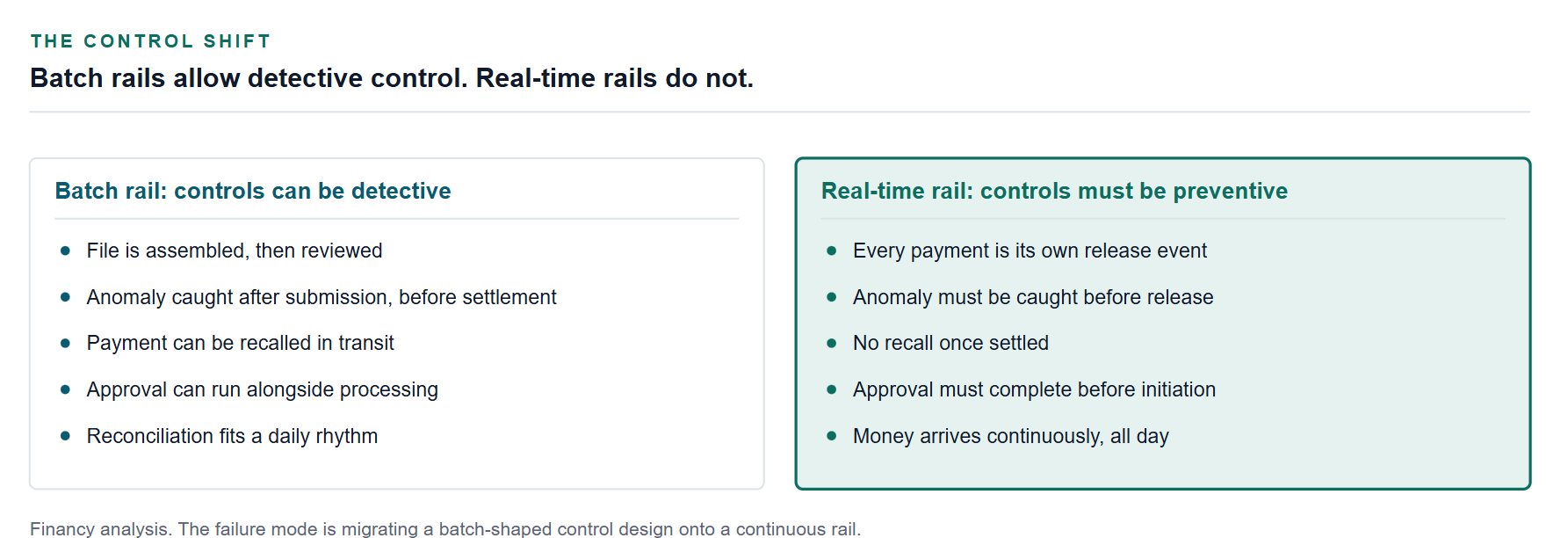
How the control model changes when settlement becomes irreversible. The left column is the process most finance teams still run.
Real-time payment rails are usually discussed as a payments story. For a finance team they are a working capital story, a fraud story and a reconciliation story, and those three consequences arrive whether or not the finance function was part of the decision to adopt them.
The adoption curve is no longer theoretical. The Federal Reserve's FedNow Service settled 4,997,811 payments in the second quarter of 2026, up 83.2 per cent on the previous quarter, while the value moved rose only 1.3 per cent. The average payment fell from $99,414 to $54,957 in a single quarter. That is a rail changing character, from a low-volume corporate instrument into something closer to everyday operational use.
The float disappears
Traditional payment methods carry a settlement delay, and finance functions have long planned around it. That gap is a form of working capital. It also provides an interval in which an error can be caught before money is irretrievably gone.
Instant settlement removes both. The working capital effect is manageable with forecasting. The error-correction effect is more significant: a payment sent in error can no longer be stopped in transit, which moves the entire control burden to before the payment is released rather than after.
Controls move earlier and get harder
In a batch world, controls can be partly detective. Review the file, catch the anomaly, cancel before settlement. In a real-time world, controls must be preventive and must execute in the time available before release, which is very short.
Practically, that means approval workflows have to complete before the payment is initiated rather than alongside it, payee verification becomes materially more important, and limits and thresholds have to be configured deliberately rather than inherited from the previous process. Teams that migrate their old control design onto a real-time rail generally discover the mismatch through an incident.
Regulators have reached the same conclusion from the other direction. Under the EU Instant Payments Regulation, euro-area payment service providers have had to be able to receive instant euro payments since 9 January 2025 and to send them since 9 October 2025, and the same October date obliged them to offer a verification of payee service free of charge. Payee verification stopped being a competitive feature and became a condition of operating the rail.
Fraud economics change for the attacker too
Irreversibility is valuable to a fraudster. Authorised push payment fraud, in which a victim is deceived into sending a payment themselves, works precisely because the payment is genuine, authorised and fast. Traditional fraud controls are built to detect unauthorised transactions and are weak against this pattern by design, because the transaction is not unauthorised.
The UK numbers show the shape of it. UK Finance reported total payment fraud losses of GBP 1.28 billion in 2025. Unauthorised fraud fell 5 per cent to GBP 703.4 million. Authorised push payment fraud went the other way, rising 19 per cent to GBP 576.4 million across 248,070 cases. Two thirds of those cases originated online. The controls that work on card fraud are not the controls that work here.
Where liability sits for an authorised payment made in error is not uniform across markets, and it is changing in several of them. Know the answer for each market you operate in before you adopt the rail, not after.
Reconciliation gets easier and busier
Real-time rails generally carry richer remittance information than legacy alternatives, which improves automated matching. That is a genuine gain, and the migration of Fedwire to ISO 20022 on 14 July 2025, followed by the end of Swift MT and ISO coexistence for cross-border traffic on 22 November 2025, has widened the amount of structured data travelling with a payment.
The offsetting effect is volume and timing. Payments arrive continuously rather than in predictable batches, so a daily reconciliation rhythm no longer maps to how money actually moves. Teams that keep a batch-shaped process on a continuous rail report a good deal of avoidable manual work, and the problem tends to be organisational rather than technical: the close calendar, the cash position and the exception queue are all built around a cut-off that the rail has removed.
One more date is worth putting in the plan. From November 2026, Swift cross-border payments and Fedwire enforce structured or hybrid postal addresses, phasing out fully unstructured ones. Address data that has been tolerated for years becomes a rejection reason.
What to ask before adopting
Which of our controls are detective, and which of those now need to become preventive?
Who verifies payee details, by what method, and at what point in the flow?
What are our limits and thresholds, and were they set for this rail or inherited from the last one?
Where does liability sit for an authorised payment made in error, in each market we operate in?
Does our reconciliation process still assume a batch that no longer exists?
Is our address and remittance data clean enough for the structured-format deadlines already scheduled?
None of these questions is difficult. They are simply easier to answer before the rail is live than after the first irreversible mistake.
This is reporting on financial technology and operations. It is not investment, legal, accounting or tax advice.
References
Every figure and legal citation in this article is drawn from the sources below. Where an instrument is proposed rather than in force we say so in the text.
Federal Reserve Financial Services, FedNow Service volume and value statistics, page updated 6 July 2026. https://www.frbservices.org/resources/financial-services/fednow/volume-value-stats
European Commission, New EU rules make instant euro payments faster and safer, 10 October 2025. https://finance.ec.europa.eu/news/new-eu-rules-make-instant-euro-payments-faster-and-safer-2025-10-10_en
European Central Bank, Instant Payments Regulation. https://www.ecb.europa.eu/paym/retail/instant_payments/html/instant_payments_regulation.en.html
UK Finance, Annual Fraud Report 2026, 15 June 2026. https://www.ukfinance.org.uk/news-and-insight/press-release/fraud-report-2026-press-release
Association for Financial Professionals, No more delays: the ISO 20022 Fedwire deadline is here. https://www.financialprofessionals.org/training-resources/resources/articles/Details/no-more-delays-the-iso-20022-fedwire-deadline-is-here
J.P. Morgan, ISO 20022 migration. https://www.jpmorgan.com/insights/payments/fx-cross-border/iso-20022-migration
How we work. This article was researched and written by the Financy editorial team. We do not republish press releases. Every number and legal citation is checked against a primary source, which is named and linked above. Where an instrument is proposed rather than in force, we say so. Corrections are made openly on the article itself, never by silent edit. If you believe something here is wrong, write to info@financyhub.com and tell us what and why.
Filed under Payments & Digital Wallets · Get The Weekly Brief