
Instant rails crossed into everyday volume, cheques fell to a quarter of business payments and remain the most defrauded instrument. A sourced review of where the numbers actually are.
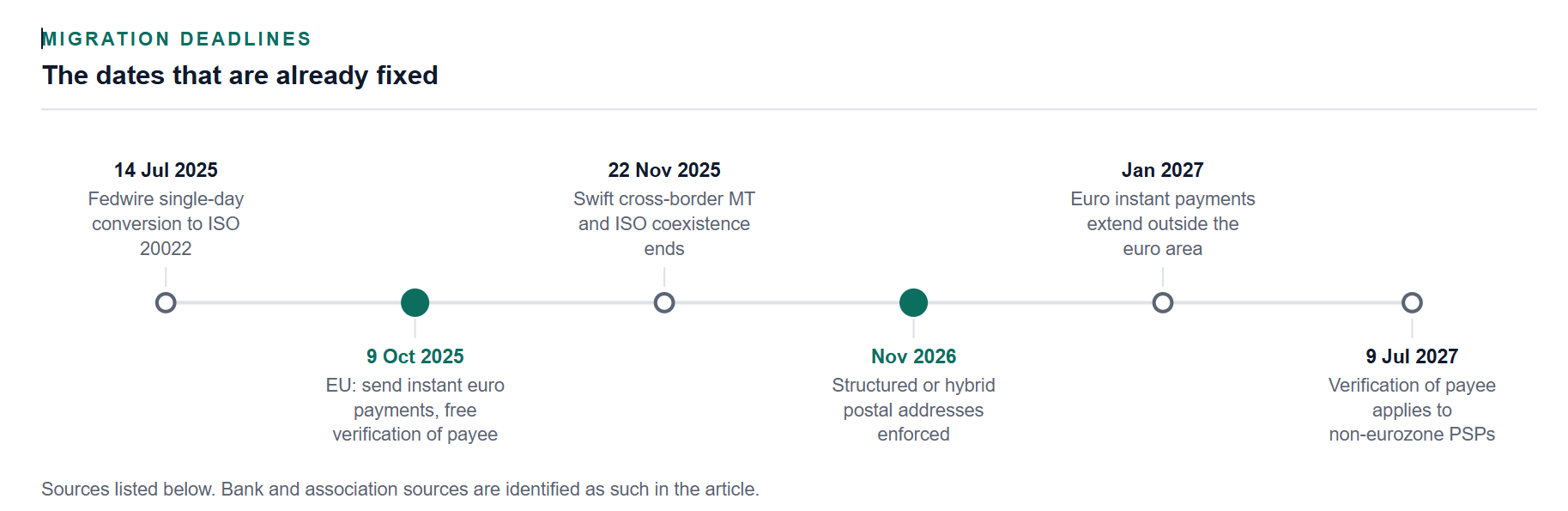
Instrument and infrastructure deadlines with a confirmed date. Anything still in consultation is excluded.
This is a sourced review of published data, not an original survey. Every figure below names its publisher and its period, and where the only available source is a bank, an association or a commercial provider rather than the operator itself, we say so.
We are flagging that because this category is unusually polluted. Payments statistics are quoted freely, frequently without a date, and at least one widely circulated set of real-time payment figures currently being passed around as 2026 data is from 2024.
Instant rails: the shape changed, not just the size
The FedNow Service settled 4,997,811 payments in the second quarter of 2026, up 83.2 per cent on the prior quarter, worth $274.7 billion, up 1.3 per cent. Volume nearly doubled while value was flat, so the average payment fell from $99,414 to $54,957 in one quarter. For the full year 2025 the service settled 8,413,402 payments worth $853.4 billion, against 1,505,250 payments worth $38.2 billion in 2024.
That is a rail changing character. A service moving a small number of large corporate payments has become one moving a large number of ordinary ones.
On The Clearing House's RTP network, 1 May 2026 produced single-day records of 2.27 million transactions worth $8.62 billion. The first day at or above two million transactions was 13 February 2026. The network's chief product officer described instant payments as approaching $500 billion in value each quarter and more than 1.5 million transactions each day, with RTP processing over 98 per cent of the US economy's bank-to-bank instant payments and a transaction limit of $10 million. Instant tax refund disbursements across federal, state and local government rose 78 per cent in the first four months of 2026 against the same period in 2025.
A widely repeated figure to avoid. Search results still surface RTP quarterly figures of 82 million transactions and $55 billion in value as though they were current. They are from the second quarter of 2024. No RTP quarterly release for the second quarter of 2026 had been published as at 30 July 2026.
In the UK, Pay.UK reported 5.548 billion Faster Payments transactions in 2025, up 9.0 per cent, worth GBP 4.838 trillion, up 14.0 per cent. Single immediate payments carried most of the growth at 4.738 billion transactions, up 10.8 per cent. In the same dataset, cheques cleared through image clearing fell 15.7 per cent by volume to 78.7 million items.
Outside the mature markets the scale is different by an order of magnitude. India's UPI processed 22.72 billion transactions in June 2026 worth Rs 28.92 lakh crore, roughly 757 million transactions a day, with the user base at 55.49 crore. Brazil's Pix recorded 79.8 billion transactions in 2025 worth R$35.36 trillion, value up 33.6 per cent, reaching 54.7 per cent of Brazil's retail payment transactions in the second half of 2025, with person-to-business overtaking person-to-person from September 2025. Both sets of figures reach us through secondary reporting of the operators rather than from the operators' own pages, and should be verified at source before being used in a document that matters.
The deadlines that are already fixed
Under the EU Instant Payments Regulation, euro-area providers have had to be able to receive instant euro payments since 9 January 2025 and to send them since 9 October 2025, with a free verification of payee service required from the same October date. Euro instant payments extend outside the euro area in January 2027, and the verification of payee obligation reaches non-eurozone providers on 9 July 2027.
On messaging, Fedwire converted to ISO 20022 in a single-day cutover on 14 July 2025, retiring the previous format entirely. Swift's cross-border coexistence period ended on 22 November 2025, after which the legacy payment instruction message types are rejected. In November 2026 both Swift cross-border and Fedwire begin enforcing structured or hybrid postal addresses, phasing out fully unstructured ones.
That last one is the quiet operational risk in most finance functions. Address data that has been tolerated for a decade becomes a rejection reason on a known date.
Fraud: both sides of the Atlantic, and the pattern is the same
The US Federal Trade Commission reported about $16 billion lost to all types of fraud in 2025, the highest on record and up about 25 per cent on 2024. Imposter scams accounted for $3.5 billion and were the most-reported category, appearing in nearly one in three fraud reports, with losses up nearly threefold since 2020. Business impersonators accounted for nearly $1 billion, with the highest losses attributed to bank impersonators.
In the UK, UK Finance reported total payment fraud losses of GBP 1.28 billion in 2025, up 4 per cent. The composition is the point. Unauthorised fraud fell 5 per cent to GBP 703.4 million even as case volumes rose 11 per cent. Authorised push payment fraud rose 19 per cent to GBP 576.4 million across 248,070 cases, with investment fraud the largest component at GBP 221.5 million, up 40 per cent. Two thirds of authorised push payment cases originate online, accounting for 32 per cent of losses, while telecommunications account for 17 per cent of cases but 28 per cent of losses. Banks refunded GBP 354.3 million, or 61 per cent of authorised push payment losses.
The controls that work on card fraud are getting better. The category that is growing is the one where the customer authorised the payment. Those are different problems and only one of them is being solved.
The cheque is nearly gone, and it is still the biggest fraud target
The Association for Financial Professionals' triennial digital payments survey, released 23 September 2025, found cheques at 26 per cent of outgoing business-to-business payments, a new low, down from 81 per cent in 2004 and 33 per cent in 2022. On the receiving side, cheques were 25 per cent of business-to-business receipts, from 75 per cent in 2004.
Alongside that, the 2026 AFP payments fraud survey, fielded in January 2026 across 465 treasury practitioners, found more than 75 per cent of US firms experienced payments fraud in 2025, and 58 per cent reporting cheques as subject to fraud, making it the most-targeted method.
A quarter of business payment volume, and the single largest fraud exposure. That disproportion is the strongest argument for finishing the migration that most organisations have left at ninety per cent complete.
For context on where the volume went: Nacha reports business-to-business ACH volume up 155 per cent from 2015 to 2024, from 2.9 billion to 7.4 billion payments, with value up 105 per cent from $28.3 trillion to $58.2 trillion.
What we could not verify
Two things, and we would rather name them than fill them.
First, finance-function technology spend. We found no verifiable figure for technology spend or automation adoption specific to the finance function. All-industry technology spend forecasts exist, but applying one to the finance function is a guess dressed as data.
Second, the card against account-to-account share. Figures from the major payments report circulating in 2026 put digital wallets at 56 per cent of global e-commerce transaction value and 33 per cent of in-store spend, with account-to-account projected at 13 per cent of e-commerce transaction value by 2030. We reached those through coverage rather than the report itself, and the 13 per cent figure may be regional rather than global. Treat as indicative and pull the report before quoting.
What a finance team should take from this
The instant rails are past the pilot phase in every market covered here, and the average transaction size is falling, which means the volume is operational rather than exceptional.
Two migration deadlines are already fixed and both are data-quality problems rather than technology problems: structured addresses in November 2026, and verification of payee for non-eurozone providers in July 2027.
Fraud exposure is shifting from the unauthorised category, where controls are improving, to the authorised category, where they are weaker by design.
If you still issue cheques, you are in a shrinking minority holding the largest single fraud exposure in the survey data.
Check the date on any payments statistic before you use it. In preparing this piece, the most-surfaced RTP figures were two years old and presented as current.
This is reporting on financial technology and operations. It is not investment, legal, accounting or tax advice.
References
Every figure and legal citation in this article is drawn from the sources below. Where an instrument is proposed rather than in force we say so in the text.
Federal Reserve Financial Services, FedNow Service volume and value statistics, page updated 6 July 2026. https://www.frbservices.org/resources/financial-services/fednow/volume-value-stats
The Clearing House, RTP network marks May Day with record-breaking volume and value, 14 May 2026. https://www.theclearinghouse.org/payment-systems/Articles/2026/05/RTP-Network-Marks-May-Day-with-Record-Breaking-Volume-and-Value
The Clearing House, Cash flow needs from consumers and businesses drive new RTP network volume and value records, 25 February 2026. https://www.theclearinghouse.org/payment-systems/Articles/2026/02/Cash-Flow-Needs-from-Consumers-and-Businesses-Drive-New-RTP-Network-Volume-and-Value-Records
Pay.UK, Annual summary of payment statistics 2025, February 2026. https://www.wearepay.uk/wp-content/uploads/2026/02/Annual-Statistics-2025-v1.3.pdf
Entrackr, reporting NPCI data, UPI clocks 22.72 billion transactions in June 2026, July 2026. https://entrackr.com/news/upi-clocks-2272-bn-transactions-worth-rs-2892-lakh-cr-in-june-12122397
ClearingPost, reporting Banco Central do Brasil data, Pix breaks all records in 2025. https://clearingpost.com/insights/pix-breaks-all-records-in-2025-798-billion-transactions-move-r-3536-trillion/
European Commission, New EU rules make instant euro payments faster and safer, 10 October 2025. https://finance.ec.europa.eu/news/new-eu-rules-make-instant-euro-payments-faster-and-safer-2025-10-10_en
European Central Bank, Instant Payments Regulation. https://www.ecb.europa.eu/paym/retail/instant_payments/html/instant_payments_regulation.en.html
Association for Financial Professionals, No more delays: the ISO 20022 Fedwire deadline is here. https://www.financialprofessionals.org/training-resources/resources/articles/Details/no-more-delays-the-iso-20022-fedwire-deadline-is-here
US Federal Trade Commission, FTC data show people reported losing $3.5 billion to imposter scams in 2025, 15 June 2026. https://www.ftc.gov/news-events/news/press-releases/2026/06/ftc-data-show-people-reported-losing-3-point-5-billion-imposter-scams-2025
UK Finance, Annual Fraud Report 2026, 15 June 2026. https://www.ukfinance.org.uk/news-and-insight/press-release/fraud-report-2026-press-release
Nacha, Over 21 years, massive drop in B2B check payments, study finds, on the AFP Digital Payments Survey 2025, 24 September 2025. https://www.nacha.org/news/over-21-years-massive-drop-b2b-check-payments-study-finds
Association for Financial Professionals, Over 75 per cent of US firms experienced payments fraud in 2025, 2026 Payments Fraud and Control Survey. https://www.financialprofessionals.org/about/learn-more/press-releases/Details/over-75-percent-of-us-firms-experienced-payments-fraud-in-2025-while-ai-adoption-for-fraud-mitigation-lags
How we work. This article was researched and written by the Financy editorial team. We do not republish press releases. Every number and legal citation is checked against a primary source, which is named and linked above. Where an instrument is proposed rather than in force, we say so. Corrections are made openly on the article itself, never by silent edit. If you believe something here is wrong, write to info@financyhub.com and tell us what and why.
Filed under Payments & Digital Wallets · Get The Weekly Brief