
A review of the published benchmarks, including the two definitional traps that make most close comparisons meaningless.
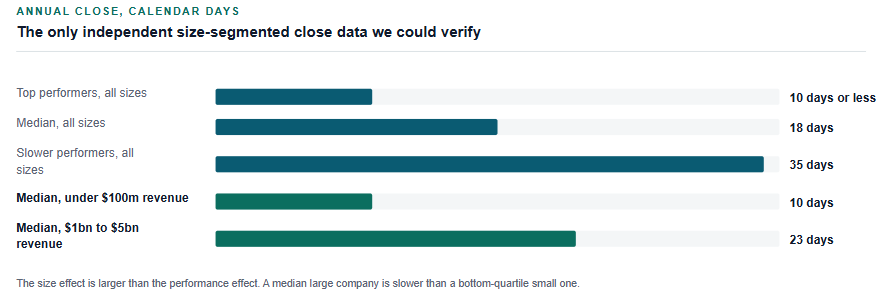
APQC annual close cycle time, measured in calendar days from running the trial balance to completing the consolidated financial statements. Published 8 April 2026. Sample size and collection period are not stated on the source page.
This is a benchmark review, not original research. We have not surveyed anyone. What follows is what the published data actually says about how long the financial close takes, which sources are independent, and the two definitional problems that make most of the comparisons in circulation worthless.
We are being explicit about that because the alternative is common and dishonest. A publication that presents a synthesis of other people's benchmarks as its own study is not producing research, and readers in this audience can tell.
Trap one: calendar days and business days are not the same quantity
APQC measures the close in calendar days, from running the trial balance to completing the consolidated financial statements. Most vendor commentary speaks in business days. A six-day figure from one source and a six-day figure from another can differ by roughly forty per cent in real elapsed time, and they appear in the same tables constantly.
If a benchmark does not state its unit, it is not usable. If a comparison mixes units, it is not a comparison.
Trap two: monthly, quarterly and annual close are three different metrics
They are routinely conflated in secondary literature. APQC's annual figures of roughly 10, 18 and 35 calendar days sit in the same paragraphs as monthly figures of roughly 5, 6 and 10 in a great deal of published commentary. They measure different processes with different scopes.
What the independent data says
APQC, published 8 April 2026, on the annual close: top performers complete in 10 calendar days or less, the median is 18 days, and slower performers take 35 days. The sample size and collection period are not stated on that page, which is a limitation worth carrying.
The size segmentation is the most useful part and the least reproduced. Organisations with less than $100 million in annual revenue report a median annual close of 10 days. Organisations between $1 billion and $5 billion report a median of 23 days.
Read those two numbers together and the implication is uncomfortable for benchmark culture. The median large company takes longer than the slower end of the small-company distribution. The variable doing most of the work is not process maturity, it is entity count, system count, currency count and the number of upstream owners who have to deliver something before accounting can begin. APQC says as much on the same page, noting that cycle time varies by organisation size, complexity and compliance requirements, and that peer-group comparison is required rather than a universal target.
APQC also reports that 31 per cent of organisations actively use AI in record-to-report processes, with a further 39 per cent in early stages of adoption.
The monthly close: the number everyone quotes, and it does not check out
APQC's monthly close quartiles sit behind a members-only paywall. The two secondary citations of them in wide circulation disagree with each other.
One, published by an ERP reseller in June 2026, states that based on responses from more than 10,000 organisations, top performers complete monthly consolidated financial statements in five days or less, median performers need six days, and bottom performers require ten or more calendar days. The other, published by a close-automation vendor in January 2024, attributes the data to a 2017 APQC survey of 2,300 organisations with a median of six calendar days, and its chart states top performers at 4.8 days, bottom at 10 and median at 6.4.
Same underlying source, allegedly. Sample of 2,300 against more than 10,000. Median of 6.0 against 6.4. Top quartile of five days or less against 4.8. Neither links to a retrievable APQC document.
We are not printing a monthly close benchmark. If you use one, name the secondary source you took it from and state that the citations in circulation conflict. That is more useful to a reader than a confident number.
What the vendor-sponsored research adds, labelled as such
Two datasets are worth reporting with their provenance attached, because they are the only quantified evidence available on questions that matter operationally.
The first is Ventana Research, in work sponsored by a close-automation vendor and dated 2021, with no stated sample size or collection period. It reports that only 53 per cent of companies complete the monthly close within six business days and 40 per cent do so for the quarterly close. Companies using spreadsheets rarely take an average of 5.5 days to close monthly books; those using them substantially take 7.7. Of organisations that had automated reconciliations, 60 per cent closed quarterly books within six working days, against 38 per cent of those that had not. And 77 per cent of companies that periodically review close performance were able to shorten it, against 15 per cent of those that do not.
That last pairing is the one we would put in front of a board. The largest reported differential in the dataset is not attached to software at all. It is attached to whether anyone looks at the process on purpose.
The second is a 2025 survey of 100 finance professionals published by a reconciliation-automation vendor. It reports 94 per cent of teams using Excel in the month-end close, with 50 per cent citing it as a key reason the close is slow, and most teams automating less than 40 per cent of the close. Its distribution of monthly close length is: 18 per cent at one to three business days, 32 per cent at four to five, 23 per cent at six to seven, and 27 per cent at more than seven. Its top-cited blocker is dependency on other departments and regions at 56 per cent, ahead of Excel at 50 per cent and legacy systems at 40 per cent.
Provenance matters more than usual here. Only two sources in this entire area are independent: APQC and, for the external deadlines, the SEC. Every other source quantifying close duration is a vendor or vendor-sponsored, and each of those vendors sells close-acceleration software or ERP services. We have reported their figures because they are the only ones available on those questions, and labelled every one.
The one hard external constraint
Whatever the benchmark says, the filing deadlines are not negotiable for a registrant. Form 10-K is due 60 days after fiscal year end for large accelerated filers, 75 days for accelerated filers and 90 days for all other registrants. Form 10-Q is due 40 days after quarter end for both large accelerated and accelerated filers, and 45 days for all other registrants, with no 10-Q for the fourth quarter.
Those figures put the APQC medians in perspective. An 18-day median annual close against a 60-day filing deadline is not the binding constraint. The audit, the disclosure drafting and the review cycle are, which is a reminder that close acceleration and reporting acceleration are different projects.
What to do with all of this
Benchmark within your revenue band or do not benchmark. The size effect in the independent data is larger than the performance effect.
State your unit. Calendar or business days, and monthly, quarterly or annual. Most internal targets we have seen do not.
Do not import a target from a case study without checking both of the above.
If you want the highest-leverage intervention in the published evidence, it is periodic review of the close process itself, which is free.
Treat any vendor figure as directional. Treat any figure with no sample size and no collection period, including some of the independent ones, as directional too.
The honest position is that this is a poorly measured area. The best independent dataset does not publish its sample size on the page, the most-quoted figures sit behind a paywall and are cited inconsistently, and the richest operational detail comes from parties selling the remedy. A finance function is entitled to know that before it sets a target it will be judged against.
This is reporting on published benchmark data. It is not accounting, audit or investment advice. Figures are reproduced from the sources named and we state which are independent and which are vendor-sponsored.
References
Every figure and legal citation in this article is drawn from the sources below. Where an instrument is proposed rather than in force we say so in the text.
APQC, How to streamline the annual closing process and speed year-end close, 8 April 2026. https://www.apqc.org/resources/blog/how-streamline-annual-closing-process-and-speed-year-end-close
APQC, Cycle time in days to perform annual close, measure definition. https://www.apqc.org/what-we-do/benchmarking/open-standards-benchmarking/measures/cycle-time-days-perform-annual-close
APQC, Cycle time in days for finance shared services centre to complete the monthly financial close. https://www.apqc.org/what-we-do/benchmarking/open-standards-benchmarking/measures/cycle-time-days-finance-shared
Rand Group, How long should month-end close take, secondary citation of APQC data, vendor-sponsored, published 1 June 2026. https://www.randgroup.com/insights/services/how-long-should-month-end-close-take-benchmarks-red-flags-and-best-practices/
Numeric, How long does month-end close take, secondary citation of APQC data, vendor-sponsored, 22 January 2024. https://www.numeric.io/blog/how-long-does-month-end-close-take
Ventana Research, Best Practices for a More Effective Close, sponsored research, 2021. https://www.ventanaresearch.com/hubfs/Research/White_Papers_Research_Perspectives_etc/Finance/Ventana_Research_Perspective_BlackLine_Best_Practices_for_a_More_Effective_Close.pdf
Ledge, Month-end close benchmarks, survey of 100 finance professionals, vendor-published, published 10 April 2025, updated 21 July 2026. https://www.ledge.co/content/month-end-close-benchmarks-for-2025
US Securities and Exchange Commission, Form 10-K, General Instruction A(2). https://www.sec.gov/files/form10-k.pdf
US Securities and Exchange Commission, Form 10-Q, General Instruction A(1). https://www.sec.gov/files/form10-q.pdf
How we work. This article was researched and written by the Financy editorial team. We do not republish press releases. Every number and legal citation is checked against a primary source, which is named and linked above. Where an instrument is proposed rather than in force, we say so. Corrections are made openly on the article itself, never by silent edit. If you believe something here is wrong, write to info@financyhub.com and tell us what and why.
Filed under CFO Tech & FinanceOps · Get The Weekly Brief