
Adoption is measurable and it is real. Evidence that the advice itself changed is absent. Those are two different claims and the industry keeps merging them.
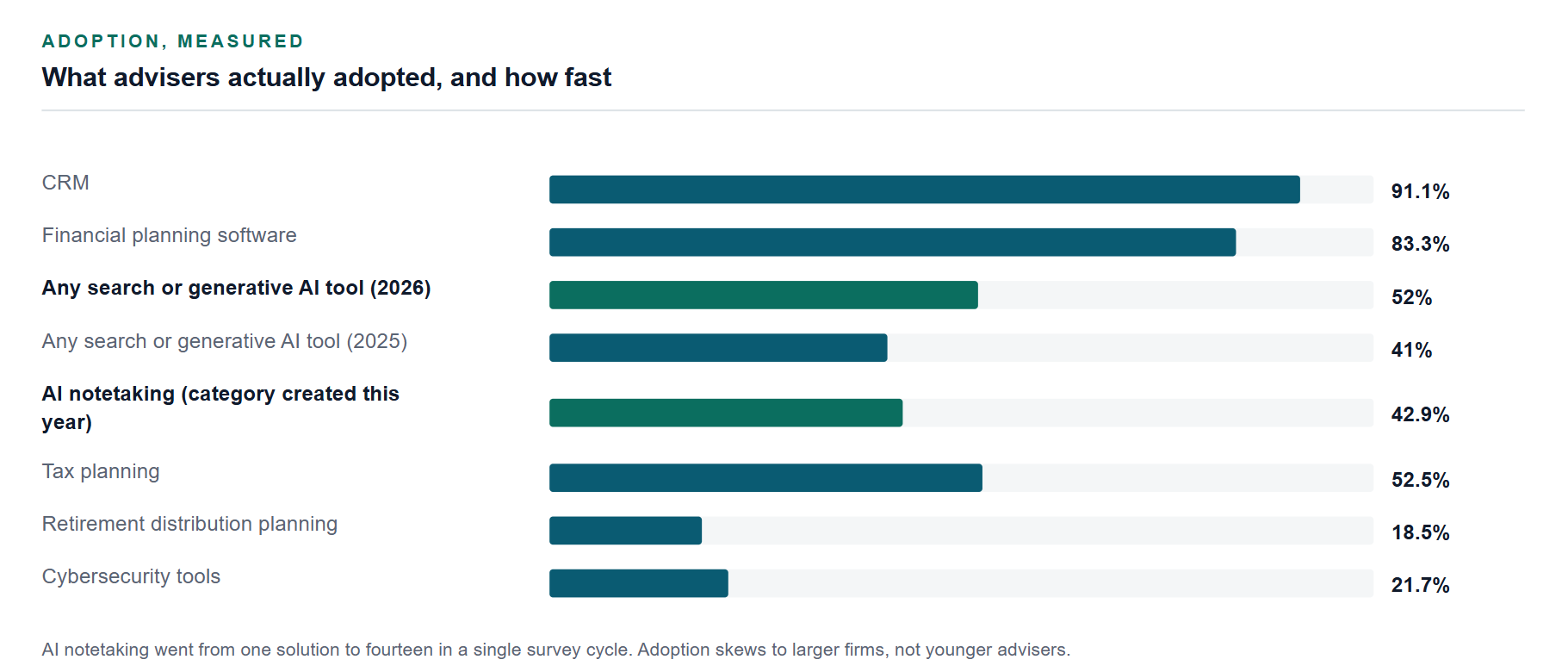
From the 2026 T3 and Inside Information Software Survey, 2,906 advisory-community respondents. The survey is sponsor-supported, and some sponsors are ranked within it. Figures are tool utilisation, not measured advice outcomes.
There are two claims made about technology in financial advice, and they are routinely presented as one. The first is that technology has changed how advice is produced and delivered. The second is that it has changed the advice. The first is well evidenced. The second, on the record available, is not evidenced at all.
What is measurable: the workflow
The clearest single data point is the arrival of AI notetaking. In the 2026 T3 and Inside Information Software Survey, across 2,906 respondents from the advisory community, AI notetaking appears as a brand-new category with fourteen solutions, up from one the previous year, at an aggregate market penetration of 42.86 per cent. Search and generative AI tool use overall rose from 41 to 52 per cent in a year.
Adoption skews larger rather than younger, which is the opposite of the usual story: more than 43 per cent of firms above $8 million in annual revenue against 32 per cent of the smallest, and advisers with twenty years of experience marginally more likely to use these tools than those with one to five years.
There is a good reason for the speed. Kitces Research puts a number on the problem being solved: the average adviser spends more than one hour on meeting preparation and follow-up client servicing for every hour spent in client meetings. A tool that compresses that is not a novelty, it is capacity.
Two details in that research are worth carrying. Adoption is highest among pure solo advisers and again among larger teams, with the middle less engaged. And the most widely adopted tool ranks lowest in adviser satisfaction, while industry-specific tools lead. Widest adoption and best tool are not the same thing here.
Alongside the AI layer, the established automation is real and long-running: automated tax-loss harvesting, asset location, tax-efficient rebalancing and fund selection, fractional-share investing and household-level planning are documented live features of at least one major digital advice programme, and digital onboarding continues to be built out by the large custodians.
What is not measurable: the advice
We looked for a dated, sourced study measuring whether technology changed recommendations, client outcomes, portfolio results or plan quality. We did not find one.
What exists in its place is a record that runs the other way. The Securities and Exchange Commission's 2021 risk alert on electronic investment advice found compliance and disclosure deficiencies to be frequent. The 2022 Schwab settlement, at roughly $187 million in total, concerned undisclosed cash-allocation drag in an automated product, which is to say the automated portfolio construction was not what it was represented to be. In March 2024 the SEC settled AI washing charges against two advisers whose claimed AI capability did not exist.
It is also worth being careful about how survey findings are used. The T3 breadth-of-service percentages are tool utilisation, and the survey's author frames the inference explicitly, saying that they believe solution utilisation equals service provided to clients. That is a belief about a proxy, honestly labelled, and it should not be re-reported as measured client outcomes.
Adoption data tells you what advisers bought. It does not tell you what clients received. Every published figure in this category measures the first thing.
The pure digital model is retreating, not advancing
The structural news of the last eighteen months is closure rather than growth. Schwab is discontinuing its hybrid digital-plus-planner tier, closing in the first quarter of 2026 and disclosed in filings in December 2025. UBS Advice Advantage and US Bank Automated Investor were shut in 2025. JPMorgan ended its robo product citing weak demand. Consolidation continues on the independent side, with Betterment having absorbed the automated investing accounts of three other providers across 2021, 2024 and 2025.
The surviving numbers need care. Wealthfront reported total platform assets of $94.1 billion at 31 January 2026, but only $48.7 billion of that is investment advisory assets, with $45.4 billion in cash management. Betterment reported more than $65 billion across more than a million customers in November 2025. Vanguard's most recent standalone figure for its pure digital programme is more than $19 billion, as at 30 June 2024.
Two of the largest incumbent robo platforms no longer break the product out at all, folding it into wider managed-solutions reporting. That non-disclosure is itself informative.
Human capacity is the constraint, and it is a demographic one
The US Bureau of Labor Statistics projects personal financial adviser employment rising from 326,000 in 2024 to 357,200 in 2034, growth of 10 per cent against 3 per cent for all occupations, with about 24,100 openings a year. Its own written assessment of the technology is measured: robo-advisers may partially temper demand, but the impact should be limited as consumers continue turning to human advisers for more complex and specialised advice.
Against that, Cerulli reported in January 2024 that over the next decade 109,093 advisers plan to retire, comprising 37.5 per cent of industry headcount and 41.5 per cent of total assets, and separately that adviser headcount has been largely unchanged, with a rookie failure rate around 72 per cent.
The gap that technology is being asked to close is therefore not primarily a preference gap. It is a headcount gap, and the tools with the fastest adoption are precisely the ones that add hours back to an existing adviser rather than replace one.
A figure we will not print. The average age of a financial adviser is quoted constantly, usually somewhere between 50 and 56. We could not find a dated primary source for it. Cerulli's own releases say only that the average age has been increasing. Every specific number we found traces to aggregator content with no citation, so we have left it out rather than repeat it.
The regulatory picture is moving toward access, not toward algorithms
In the United States, Regulation Best Interest, adopted 5 June 2019 with a compliance date of 30 June 2020, sets disclosure, care, conflict of interest and compliance obligations, requiring costs to be explicitly considered and eliminating sales contests and quotas tied to specific securities within limited periods. The rule that would have addressed algorithmic conflicts directly, the predictive data analytics proposal of July 2023, was formally withdrawn on 12 June 2025 as one of fourteen withdrawn proposals, with the Commission stating it does not intend to issue final rules on them. No replacement has been proposed.
In the United Kingdom the movement has been in the opposite direction and it is substantial. Targeted support went live on 6 April 2026, following near-final rules in December 2025 and Board confirmation on 26 February 2026, with firms able to apply for permission from 2 March 2026. Targeted support allows suggestions designed for groups of consumers with common characteristics, which is a new regulatory category sitting between guidance and personal advice. The FCA's stated rationale is scale: around 23 million consumers are currently underserved by the markets for advice and guidance, against 9 per cent of UK adults who received regulated financial advice in the previous twelve months.
The honest summary
Technology has changed the production of advice considerably and quickly. It has changed the distribution of advice more slowly than promised, and the pure digital distribution model is contracting rather than expanding. Whether it has changed the advice itself is, on the published record, an open question that nobody has attempted to answer with data.
That is not a criticism of the tools. It is an observation about what the industry chooses to measure. Utilisation is easy to count and flattering to report. Outcome is neither.
This is reporting on the technology and regulation of financial advice. It is not investment advice, and nothing here is a recommendation about any product, provider or investment.
References
Every figure and legal citation in this article is drawn from the sources below. Where an instrument is proposed rather than in force we say so in the text.
Business Wire, Key wealthtech and AI findings from the 2026 T3 and Inside Information Software Survey, 2,906 respondents, 10 March 2026. https://www.businesswire.com/news/home/20260310790990/en/Live-from-T3-Key-Wealthtech-and-AI-Findings-from-the-2026-T3-Inside-Information-Software-Survey
Kitces Research, AI notetakers for financial advisers, adoption and satisfaction trends. https://www.kitces.com/blog/ai-notetakers-client-meeting-for-financial-advisors-adoption-satisfaction-trends-research-productivity/
Wealthfront, Fourth quarter and full year fiscal 2026 results, SEC Form 8-K exhibit, filed 11 March 2026. https://www.sec.gov/Archives/edgar/data/1524566/000162828026016823/q426fy2026earningsrelease.htm
Betterment, Betterment launches self-directed investing for retail customers, 11 November 2025. https://www.prnewswire.com/news-releases/betterment-launches-self-directed-investing-for-retail-customers-302611228.html
Vanguard, Vanguard expands access to advice by reducing asset minimum for Digital Advisor, 4 September 2024. https://corporate.vanguard.com/content/corporatesite/us/en/corp/who-we-are/pressroom/press-release-vanguard-expands-access-to-advice-by-reducing-asset-minimum-for-robo-service-digital-advisor-090424.html
InvestmentNews, As Schwab shutters hybrid robo, 22 December 2025. https://www.investmentnews.com/ria-news/as-schwab-shutters-hybrid-robo-josh-brown-declares-the-robo-advice-era-is-over/263663
US Bureau of Labor Statistics, Occupational Outlook Handbook, personal financial advisors, last modified 28 August 2025. https://www.bls.gov/ooh/business-and-financial/personal-financial-advisors.htm
Cerulli Associates, The financial advisor industry has a headcount problem, 16 January 2024. https://www.cerulli.com/press-releases/the-financial-advisor-industry-has-a-headcount-problem
US Securities and Exchange Commission, SEC adopts rules and interpretations to enhance protections and preserve choice for retail investors, Regulation Best Interest, 5 June 2019. https://www.sec.gov/newsroom/press-releases/2019-89
US Securities and Exchange Commission, Withdrawal of proposed rules, including predictive data analytics, 12 June 2025. https://www.sec.gov/rules-regulations/2025/06/s7-12-23
US Securities and Exchange Commission, SEC charges two investment advisers with making false and misleading statements about their use of artificial intelligence, 18 March 2024. https://www.sec.gov/newsroom/press-releases/2024-36
Financial Conduct Authority, PS25/22, supporting consumers' pensions and investment decisions, rules for targeted support, 26 February 2026. https://www.fca.org.uk/publications/policy-statements/ps25-22-consumer-pensions-investment-decisions-rules-targeted-support
How we work. This article was researched and written by the Financy editorial team. We do not republish press releases. Every number and legal citation is checked against a primary source, which is named and linked above. Where an instrument is proposed rather than in force, we say so. Corrections are made openly on the article itself, never by silent edit. If you believe something here is wrong, write to info@financyhub.com and tell us what and why.
Filed under WealthTech & Capital Markets · Get The Weekly Brief