
Mint, transfer, redeem. Three steps, two regulatory regimes moving at different speeds, and a settlement finality question that does not have a clean answer.
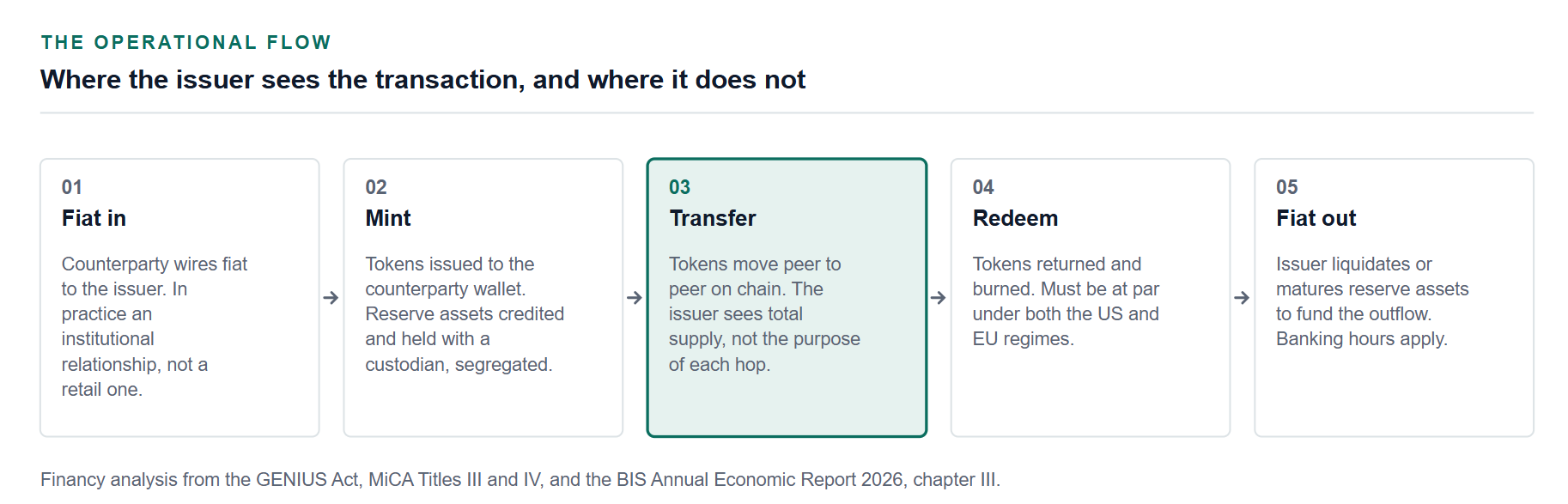
The issuer's books record the mint and the redemption. The transfers in between happen on chain, outside the issuer's ledger. That gap is the reconciliation problem.
Most writing about stablecoins is about whether they matter. This is about what happens when one is used, which is a narrower and more useful question for anyone who has to account for the result.
The flow, in five steps
Mint. A holder, in practice usually an institutional counterparty with a direct relationship with the issuer rather than a retail user, wires fiat to the issuer. The issuer credits reserve assets and mints an equivalent number of tokens to the counterparty's wallet. The issuer is the obligor. The reserve custodian, typically a bank or a custodian holding short-dated government paper and repo, holds the backing assets, legally separated from the issuer's own balance sheet.
Transfer. Tokens then move peer to peer on a blockchain, outside the issuer's books. This is the step that differs most from any other payment instrument a treasury team has used. The issuer knows total supply. It does not know the economic purpose of any individual hop. The Bank for International Settlements makes the point that these are digital bearer instruments tagged with the issuer's name, which is why different issuers' tokens can trade at different rates against the same currency.
Redeem. The holder returns tokens to the issuer, which burns them and pays fiat. Both regimes require redemption at par. Redemption is where the reserve is actually tested, because the issuer has to liquidate or mature reserve assets to fund the outflow, and the fiat leg runs on banking hours while the token leg does not.
What the two regimes require, and the asymmetry between them
United States. The GENIUS Act, Public Law 119-27, was signed on 18 July 2025. Only a permitted payment stablecoin issuer may issue: a subsidiary of an insured depository institution, a federal-qualified nonbank issuer, or a state-qualified issuer. Permitted issuers are subject to the Bank Secrecy Act, and payment stablecoins are not securities.
Reserves must back outstanding stablecoins at a minimum of one to one, in specified high-quality liquid assets: US coins and currency, demand deposits at insured depository institutions, Treasury bills with 93 days or less remaining maturity, certain repos and reverse repos, government money market funds invested solely in those assets, and Federal Reserve Bank deposits. Holders have an enforceable right to redeem at par on demand, and the issuer must publish a redemption policy with timely redemption and plain-language, capped fee disclosure. Issuers may not pay interest or yield to holders in any form; the reserve income stays with the issuer.
The disclosure regime is stricter than most commentary conveys. Monthly publication of outstanding stablecoin count and reserve amount and composition, examined monthly by a registered public accounting firm, with the chief executive and chief financial officer certifying the month-end report to the regulator and criminal exposure for false certification.
The Act takes effect on the earlier of 18 January 2027 or 120 days after the primary federal regulators issue final implementing regulations. As at 30 July 2026 the implementing rules were proposals: an OCC notice of proposed rulemaking published on 2 March 2026 creating a new 12 CFR Part 15, an FDIC proposal published on 10 April 2026 addressing deposit insurance for reserve assets and the treatment of tokenised deposits, and a joint FinCEN and OFAC proposal announced on 8 April 2026 treating permitted issuers as Bank Secrecy Act financial institutions.
Check this date on the day you rely on it. Many GENIUS Act regulations were due within one year of enactment, that is by 18 July 2026. If final rules issued around that date, a 120-day clock started and the effective date is earlier than 18 January 2027. We could not confirm the position at the time of writing, and it is the single most time-sensitive fact in this article. Verify against the Federal Register before you plan around it.
European Union. MiCA has been operating for longer. Titles III and IV, covering asset-referenced tokens and e-money tokens, applied from 30 June 2024, with the remainder from 30 December 2024. A fiat-backed stablecoin referencing a single official currency is an e-money token, and only credit institutions or electronic money institutions may issue one. Significant e-money tokens are supervised by the European Banking Authority.
Article 54 requires at least 30 per cent of funds received to be held in separate accounts at credit institutions, with the remainder invested only in secure, low-risk, highly liquid financial instruments with minimal market, credit and concentration risk, matched by maturity and credit quality to the redemption obligation. Article 49 gives holders the right to redeem at any time, at par, at face value, in funds other than electronic money, with no conditions making redemption unreasonably difficult and no fee exceeding execution cost.
The practical asymmetry for 2026: the EU rules have been live since June 2024 and the US rules are not yet effective. For anyone operating across both, Europe is the operating regime and America is the pending one.
Settlement finality, which is the part that does not resolve neatly
On a public permissionless chain there is no central authority to reverse an error or resolve a failure. Finality is chain-specific and probabilistic rather than legal finality in central bank money. The BIS puts the contrast plainly: settlement in central bank reserves ensures finality through a series of coordinated ledger updates across intermediaries and the central bank. A stablecoin transfer has no equivalent anchor.
The BIS also flags the failure modes that follow: flaws in smart contract design, weak cross-chain bridges, oracle failures and deficient governance can disrupt transfers, hinder redemptions and erode confidence. None of those are theoretical for a treasury function holding a working balance.
Reconciliation, where two true statements pull in opposite directions
Both of the following are in the same BIS chapter and both matter. Tokenisation offers a single shared record that reduces the need for reconciliation, permits simultaneous exchange and supports automated, round-the-clock operations. And fragmentation across blockchains, native multi-chain issuance and bridging reintroduce reconciliation and operational-resilience problems.
For a treasury team the practical translation is three things. The same token on different chains is not fungible in practice, whatever the balance sheet says. Round-the-clock settlement collides with banking-hours fiat legs at mint and redeem, so the working capital benefit is real for the token leg and absent for the cash leg. And the exposure being carried is the issuer's reserve liquidity profile, not the blockchain.
Scale, with the caveat that matters
Stablecoin market capitalisation was approximately $320 billion at the end of May 2026, on the BIS's figure. Annual transaction volume was estimated at $28 trillion in 2025, and the BIS's own framing of that number should travel with it: it is equivalent to less than three business weeks of settlement volumes of the largest US wholesale payment systems, and values net of transactions between wallets owned by the same party are far lower.
Reserve portfolios of large fiat-backed stablecoins are heavily concentrated in dollar instruments, and their Treasury bill holdings have risen to levels comparable with those of large jurisdictions and government money market funds. The market nonetheless remains dwarfed by the trillions of dollars in bank deposits.
Figures we did not use. Several widely circulated numbers, including a claim that stablecoins settled $7.2 trillion in February 2026 and surpassed ACH, and a set of mid-July 2026 market capitalisations, come from commercial crypto-marketing sources, contradict one another and are not traceable to a dated primary dataset. We have used the BIS figures instead, which are lower and checkable.
The design question underneath
The BIS frames stablecoins on a continuum between money-like, meaning par redeemability at all times, low-risk reserves and credible backstops, and investment-like, meaning broader reserves, tolerated deviations from par, and redemption fees or gates. Both the GENIUS Act and MiCA push hard toward the money-like end through one-to-one reserves, par redemption and the prohibition on yield.
That is the useful lens for an operational decision. If you are treating a stablecoin balance as cash, you are relying on the money-like properties, and those properties are supplied by the reserve rules and the redemption right rather than by the technology. Read the redemption policy, not the whitepaper.
This is reporting on financial technology and market infrastructure. It is not investment advice, and nothing here is a recommendation to buy, sell or hold any asset. No price commentary is offered.
References
Every figure and legal citation in this article is drawn from the sources below. Where an instrument is proposed rather than in force we say so in the text.
United States Congress, Public Law 119-27, the GENIUS Act, signed 18 July 2025. https://www.congress.gov/119/plaws/publ27/PLAW-119publ27.pdf
Office of the Comptroller of the Currency, Bulletin 2026-3, proposed rule to implement the GENIUS Act, 25 February 2026. https://www.occ.gov/news-issuances/bulletins/2026/bulletin-2026-3.html
Federal Deposit Insurance Corporation, GENIUS Act requirements and standards for FDIC-supervised permitted payment stablecoin issuers, published 10 April 2026. https://www.federalregister.gov/documents/2026/04/10/2026-06974/genius-act-requirements-and-standards-for-fdic-supervised-permitted-payment-stablecoin-issuers-and
US Department of the Treasury, FinCEN and OFAC proposed rulemaking on permitted payment stablecoin issuers, 8 April 2026. https://home.treasury.gov/news/press-releases/sb0435
European Union, Regulation (EU) 2023/1114 on markets in crypto-assets, MiCA. https://eur-lex.europa.eu/legal-content/EN/TXT/?uri=CELEX%3A32023R1114
European Banking Authority, Asset-referenced and e-money tokens under MiCA. https://www.eba.europa.eu/regulation-and-policy/asset-referenced-and-e-money-tokens-mica
Bank for International Settlements, Annual Economic Report 2026, chapter III, the next-generation monetary and financial system, 23 June 2026. https://www.bis.org/publ/arpdf/ar2026e3.htm
Bank for International Settlements, Annual Economic Report 2025, chapter III, on singleness, elasticity and integrity, 24 June 2025. https://www.bis.org/publ/arpdf/ar2025e3.htm
How we work. This article was researched and written by the Financy editorial team. We do not republish press releases. Every number and legal citation is checked against a primary source, which is named and linked above. Where an instrument is proposed rather than in force, we say so. Corrections are made openly on the article itself, never by silent edit. If you believe something here is wrong, write to info@financyhub.com and tell us what and why.
Filed under Crypto, Blockchain & Digital Assets · Get The Weekly Brief