
Every embedded finance model is a different answer to one question: which entity is authorised. Everything else in the deal follows from that.
/
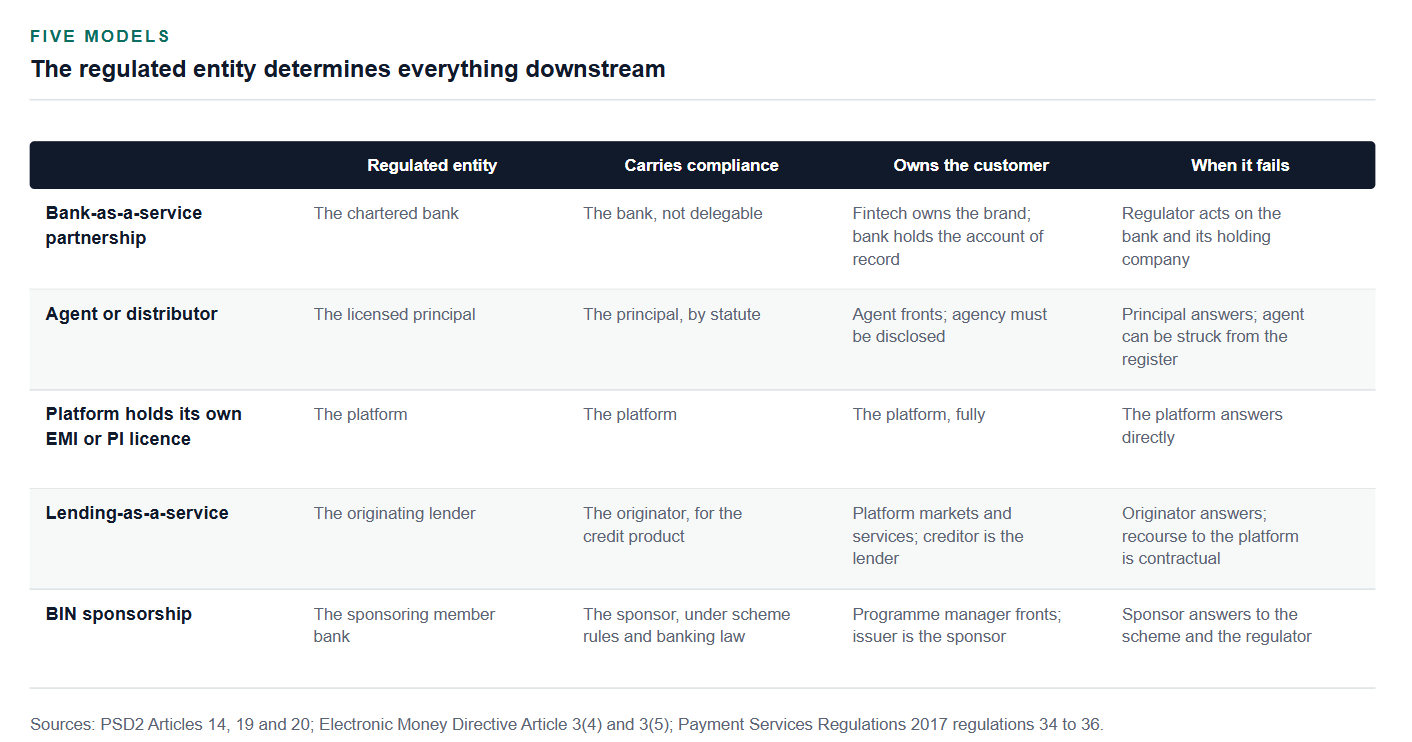
Position under PSD2 and the Electronic Money Directive in the EU, and the equivalent UK regimes. Loss-sharing and indemnities are contractual in every row and do not change the regulated entity.
Embedded finance is sold as a product decision. Add payments to your platform. Offer credit at checkout. Issue a card. In practice it is a licensing decision, and the licensing decision determines the compliance cost, the customer relationship, the speed to market and what happens on the worst day.
There are five common structures. They are usually compared on take rate and time to launch. Compared instead on who is authorised, they look very different from each other.
1. Bank-as-a-service partnership
The chartered bank is the regulated entity. The fintech is unlicensed and owns the interface, the brand and often the customer ledger. The compliance obligation sits with the bank and is not delegable, which is not a drafting preference but the consistent position of the US enforcement record: in the actions we have been able to verify, the respondent is always the bank.
Fastest of the five to launch, and the one where the two parties' interests diverge most sharply under stress. The bank can be ordered to stop onboarding, and typically the fintech finds out what its contract is worth at exactly that moment.
2. Agent or distributor of a licensed institution
The principal is authorised and the agent is registered, which is a materially different status. Under PSD2 Article 19, the home authority must be notified of the agent's name and address, the agent's anti-money laundering internal controls, the identity and fitness of its directors where the agent is not itself a payment service provider, the services mandated and a unique identification code. The authority responds within two months, and only upon entry in the register may the agent commence providing payment services.
Article 20(2) then supplies the liability rule: the payment institution remains fully liable for the acts of any agent, branch or entity to which activities are outsourced. The UK equivalent, regulation 36(2) of the Payment Services Regulations 2017, uses the same formula, and regulation 35 allows removal from the register where it is desirable to protect the interests of consumers. Registration is the lever.
One point is regularly got wrong. The Electronic Money Directive, at Article 3(5), provides that e-money institutions shall not issue electronic money through agents. They may distribute and redeem through persons acting on their behalf, and they may provide payment services through agents under PSD2. A distributor is a narrower creature than an agent and, in the UK, does not have to be registered by the regulator. If your structure assumes an agent can issue e-money, the structure is wrong.
3. The platform holds its own licence
Slowest and most expensive route, and the only one where the answer to every question is the same entity. The platform is authorised, carries its own capital and safeguarding obligations, owns the customer outright and answers to the regulator directly. Firms typically arrive here after outgrowing model 1 or 2, and the migration is a re-platforming project rather than a contractual amendment, because the account of record moves.
4. Lending-as-a-service
A bank or licensed lender originates and a platform markets and services. The creditor is the originator, and the credit product obligations, including adverse action notices where the applicant is declined, run to the originator. Compared with the payments models, much more of this structure is contractual rather than regulatory: who bears credit losses, buyback triggers, who funds redress. That flexibility is the attraction and the exposure.
The one caveat we will flag rather than resolve is that the US true lender and valid-when-made position bears directly on this model and we have not verified its current status to publication standard. Anyone structuring here should take it as a live question rather than settled ground.
5. BIN sponsorship
In card issuing, the sponsoring member bank holds the scheme licence and the regulatory obligation. The programme manager fronts the product. Two rulebooks apply at once, the scheme's and the regulator's, and the sponsor answers under both. Settlement collateral, chargeback funding and programme-manager duties are contractual.
In all five models the regulatory obligation attaches to the licence. In all five models the loss-sharing attaches to the contract. Confusing the two is the most expensive mistake available in this category.
The market-size question, and why we are not giving you a number
There is no official measurement of embedded finance. It is not a defined category in PSD2, in the Payment Services Regulations, or in EU statistics, and no statistical agency publishes a series for it. Every figure in circulation is a consultancy or vendor estimate.
The most-cited is Bain and Company's September 2022 analysis, which put US embedded finance at $2.6 trillion, nearly 5 per cent of total US financial transactions in 2021, and forecast more than $7 trillion, over 10 per cent, by 2026. Three things should be said about that figure whenever it is used. It is US-only. It measures transaction value, not revenue. And it was published by a firm whose venture arm invests in the category, forecasting the year we are now in. A 2026 article that repeats it as though it were an outturn is repeating a four-year-old projection.
The one official adjacent figure we could verify is from the European Commission, which reported electronic payments in the EU reaching EUR 240 trillion in 2021 against EUR 184.2 trillion in 2017. That is payments volume, not embedded finance, and we offer it as scale rather than as a substitute.
How to use this in a build decision
Ask which entity is authorised before you ask what the take rate is. Every other term in the deal is downstream of that answer.
Separate the regulatory obligation from the commercial allocation, on paper, in two columns. Indemnities live in the second column and do not move anything in the first.
If you are the unlicensed party, model the scenario where your partner is ordered to stop onboarding. That is the realistic bad day, not insolvency.
If you are the licensed party, assume you will be asked to evidence oversight of parties you have never met, including your partner's partners.
Check whether the structure you have been sold actually exists in the directive. E-money issued through an agent does not.
This is reporting on regulation as it stood at the date of publication. It is not legal or compliance advice, and obligations differ by jurisdiction and change. Take qualified advice on your own circumstances.
References
Every figure and legal citation in this article is drawn from the sources below. Where an instrument is proposed rather than in force we say so in the text.
European Union, Directive (EU) 2015/2366 (PSD2), Articles 14, 19 and 20. https://eur-lex.europa.eu/legal-content/EN/TXT/?uri=CELEX%3A32015L2366
European Union, Directive 2009/110/EC, the Electronic Money Directive, Article 3. https://eur-lex.europa.eu/legal-content/EN/TXT/?uri=CELEX%3A32009L0110
UK Government, The Payment Services Regulations 2017, SI 2017/752, regulations 34 to 36. https://www.legislation.gov.uk/uksi/2017/752/contents
Financial Conduct Authority, Payment Services and Electronic Money, Our Approach, version 8, May 2026. https://www.fca.org.uk/publication/finalised-guidance/fca-approach-payment-services-electronic-money-2017.pdf
Financial Conduct Authority, PS22/11, Improvements to the Appointed Representatives regime, August 2022. https://www.fca.org.uk/publications/policy-statements/ps22-11-improvements-appointed-representatives-regime
Bain and Company, Embedded finance, US market sizing and forecast, vendor research, September 2022. https://www.bain.com/insights/embedded-finance/
OCC, Federal Reserve and FDIC, Interagency Guidance on Third-Party Relationships: Risk Management, 88 FR 37920, published 9 June 2023. https://www.federalregister.gov/documents/2023/06/09/2023-12340/interagency-guidance-on-third-party-relationships-risk-management
How we work. This article was researched and written by the Financy editorial team. We do not republish press releases. Every number and legal citation is checked against a primary source, which is named and linked above. Where an instrument is proposed rather than in force, we say so. Corrections are made openly on the article itself, never by silent edit. If you believe something here is wrong, write to info@financyhub.com and tell us what and why.
Filed under Embedded Finance · Get The Weekly Brief