
The industry cannot evidence its own straight-through processing rate. That absence is why twelve state regulators built an evaluation tool.
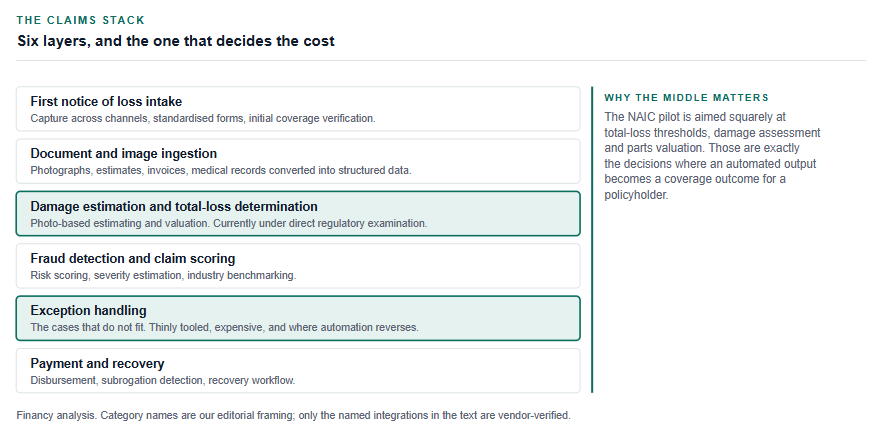
Automation is usually bought on the happy path. Loss adjustment expense and leakage are concentrated in the exception queue, which is the layer with the least tooling and the most regulatory attention.
Every claims automation pitch is built on the same arithmetic: a percentage of claims that can be handled without a human. Ask which percentage, and where the figure comes from, and the ground gives way.
We looked for a straight-through processing rate for insurance claims attributable to a named, dated research organisation. There is not one. Every figure in open circulation traces back to a vendor marketing page. The numbers range from below 10 per cent industry-wide to leaders at 20 to 40 per cent to a claimed 70 to 90 per cent, and none is traceable to a dataset with a sample size and a collection period.
The industry cannot evidence its own straight-through processing rate. That is not a gap in the reporting. It is the finding, and it is the reason regulators have stopped asking and started examining.
Twelve states are now looking directly
The National Association of Insurance Commissioners has moved from model guidance to examination. Its AI Systems Evaluation Tool pilot, developed by the Big Data and Artificial Intelligence Working Group, runs from March 2026 to September 2026 across twelve states: California, Colorado, Connecticut, Florida, Iowa, Louisiana, Maryland, Pennsylvania, Rhode Island, Vermont, Virginia and Wisconsin.
It assesses four areas: the extent of AI use, internal governance, systems classified as high risk, and input data. Insurers are required to take full responsibility for AI platforms bought from third-party vendors, which is the same principle that governs bank-fintech partnerships and lands in the same place. The tool is to be revised between September and October 2026, then put out for public review, with a vote on nationwide adoption scheduled for the NAIC's autumn national meeting in November 2026.
The NAIC has reported that 88 per cent of auto insurers currently use or plan to use AI to evaluate claims. Industry trade groups filed a joint objection in December 2025, arguing the programme is voluntary for regulators while compulsory for companies.
Behind the pilot sits the NAIC Model Bulletin on the use of artificial intelligence systems by insurers, adopted 4 December 2023. As at 1 April 2026 the NAIC's own implementation map records 25 adopted jurisdictions, being 24 states and the District of Columbia. Four further states have insurance-specific AI regulation or guidance outside the model bulletin, including Colorado, whose amended regulation took effect on 15 October 2025 and requires insurers using external consumer data and information sources, algorithms and predictive models to submit a compliance summary report from 1 July 2026 and annually thereafter.
The European deadline moved, and the pressure did not follow it
Annex III point 5(c) of the EU AI Act classifies as high-risk AI systems intended to be used for risk assessment and pricing in relation to natural persons in life and health insurance. Those obligations were to apply from 2 August 2026. They now apply from 2 December 2027, deferred by the Digital Omnibus on AI, which was adopted by Parliament on 16 June 2026 and by Council on 29 June 2026 and entered into force in July 2026.
The practical consequence is worth stating plainly, because it inverts the usual assumption. European insurers gained sixteen months. American state regulators moved forward in the same quarter. The regulatory pressure on claims AI through 2026 and 2027 is American, not European.
The litigation is about exception handling, whether or not it says so
Two US cases are shaping expectations. In the UnitedHealth Group litigation over the nH Predict tool and post-acute care denials, filed in Minnesota in November 2023, the court dismissed five of seven counts in February 2025, several as preempted by the Medicare Act, but allowed breach of contract and breach of the implied covenant of good faith and fair dealing to proceed. In March 2026 a magistrate judge ordered broad discovery into how the tool was built, its intended purpose, whether it was designed to substitute for a physician's judgment, who trained staff on it and what government investigators had requested, with twenty-one days to produce.
In the Cigna litigation over the PXDX review process, a federal judge in California denied in part a motion to dismiss, allowing at least some plaintiffs to proceed on an ERISA breach of fiduciary duty claim.
Read as technology stories these are stories about models. Read as operational stories they are about what happens to a case that does not fit the automated path, and whether a human ever meaningfully looked at it. That is exception handling.
Where automation is being fenced off, and it is not where you would expect
The clearest verifiable retreat is not carriers rolling back claims automation. It is carriers excluding AI liability from the policies they sell. Since 1 January 2026, Verisk and ISO exclusion endorsements have allowed removal of generative AI exposure from commercial general liability cover. Berkshire Hathaway and Chubb have won approval for AI exclusions, and further filings were made in 2026. One published form is an absolute AI exclusion for directors and officers, errors and omissions, and fiduciary liability.
An industry that is confident in a technology does not simultaneously write it out of the cover it sells. That tension is the most honest signal available on how the risk is actually assessed.
What is verifiable about the tooling
We could not find an analyst-house category taxonomy worth quoting, so the layers in the diagram above are our own framing. What is verifiable is that the integration seams are real and named. CCC integrates AI, photo-based estimating and repair workflow directly into Guidewire ClaimCenter, and its subrogation product is a validated accelerator in the Guidewire marketplace. Verisk analytics score claims for fraud risk, estimate severity and benchmark against industry averages, and the ISO forms library supplies standardised first notice of loss, loss report and coverage verification forms across all fifty states.
On the underlying claims mix, CCC data shows repairable claims down 10.4 per cent through August 2025 year on year, with total-loss frequency at 22.8 per cent through October 2025, on pace for a second consecutive record. A shrinking repairable pool and a growing total-loss pool moves volume toward exactly the decision the NAIC pilot is examining.
Integration, not adoption, is the constraint
A 2026 survey of 750 property and casualty professionals found only 23 per cent of insurers reporting AI fully integrated into their systems, and a 64-point gap between the 91 per cent of leaders who report real-time portfolio control and the 27 per cent of underwriters who do. Insurers with fully integrated AI were 3.6 times more likely to report that control.
That gap between what leadership believes is running and what the people operating the process experience is the most useful number in this article, and it is the same gap that shows up in claims: the automated path is well understood at the top of the house, and the exception queue is where the work actually lives.
How to evaluate a claims platform, then
Ask what proportion of claims exit the automated path, and what happens to them. A vendor who can answer the second half is more credible than one who quotes a high figure for the first.
Ask for the exception taxonomy. If exceptions are one bucket, they are not being managed.
Ask how a decision is reconstructed. The discovery orders in the current litigation are asking exactly that: how the tool was built, what it was intended for, and whether it replaced human judgment.
Ask who is responsible for a third-party model. Under the NAIC pilot the answer is the insurer, in full.
Treat any straight-through processing figure without a sample size and a collection period as marketing. On the current evidence, none of them has one.
On leakage, the most defensible published estimate we found puts indemnity and leakage at approximately 7 to 14 per cent of total spend on litigated casualty claims, with inaccurate damage evaluations and missed settlement opportunities among the named root causes. The generic 5 to 10 per cent of total claims cost figure is real in circulation but we could not tie it to an originating study, so we have not leaned on it.
This is reporting on regulation as it stood at the date of publication. It is not legal or compliance advice, and obligations differ by jurisdiction and change. Take qualified advice on your own circumstances.
References
Every figure and legal citation in this article is drawn from the sources below. Where an instrument is proposed rather than in force we say so in the text.
National Association of Insurance Commissioners, AI Model Bulletin implementation map, status as at 1 April 2026. https://content.naic.org/sites/default/files/cmte-h-big-data-artificial-intelligence-wg-map-ai-model-bulletin.pdf
National Association of Insurance Commissioners, Big Data and Artificial Intelligence (H) Working Group. https://content.naic.org/committees/h/big-data-artificial-intelligence-wg
Fenwick, NAIC expands AI Systems Evaluation Tool pilot programme to 12 states, 2026. https://www.fenwick.com/insights/publications/naic-expands-ai-systems-evaluation-tool-pilot-program-to-12-states-key-updates-for-insurers-and-ai-vendors-supporting-insurers
Autobody News, Regulators open first examination of insurer AI behind total-loss decisions and claims payouts, 31 March 2026. https://www.autobodynews.com/news/regulators-open-first-examination-of-insurer-ai-behind-total-loss-decisions-and-claims-payouts
Willkie Farr and Gallagher, Colorado Division of Insurance adopts amended AI governance regulation, September 2025. https://www.willkie.com/publications/2025/09/colorado-division-of-insurance-adopts-amended-ai-governance-regulation
Sidley Austin, EU lawmakers reach provisional agreement to delay key EU AI Act obligations, 22 June 2026. https://datamatters.sidley.com/2026/06/22/eu-lawmakers-reach-provisional-agreement-to-delay-key-eu-ai-act-obligations/
ArentFox Schiff, Federal court orders broad discovery against UHC in AI coverage denial lawsuit, 2026. https://www.afslaw.com/perspectives/alerts/federal-court-orders-broad-discovery-against-uhc-ai-coverage-denial-lawsuit
Courthouse News Service, Judge advances class claims over Cigna use of automated algorithm to deny benefits. https://www.courthousenews.com/judge-advances-class-claims-over-cigna-use-of-automated-algorithm-to-deny-benefits/
Hunton Andrews Kurth, The continued proliferation of AI exclusions. https://www.hunton.com/hunton-insurance-recovery-blog/the-continued-proliferation-of-ai-exclusions
Digital Insurance, Why AI spend is increasing but full integration lags, on the Federato 2026 State of P&C Insurance Technology report, 23 July 2026. https://www.dig-in.com/news/why-ai-spend-is-increasing-but-full-integration-lags-federato
EY, Claims and litigation, indemnity and leakage on litigated casualty claims. https://www.ey.com/en_us/insights/insurance/claims-litigation
How we work. This article was researched and written by the Financy editorial team. We do not republish press releases. Every number and legal citation is checked against a primary source, which is named and linked above. Where an instrument is proposed rather than in force, we say so. Corrections are made openly on the article itself, never by silent edit. If you believe something here is wrong, write to info@financyhub.com and tell us what and why.
Filed under InsurTech · Get The Weekly Brief